
Toto Wolff Shuts Down Max Verstappen’s F1 Criticism With Bold Claim
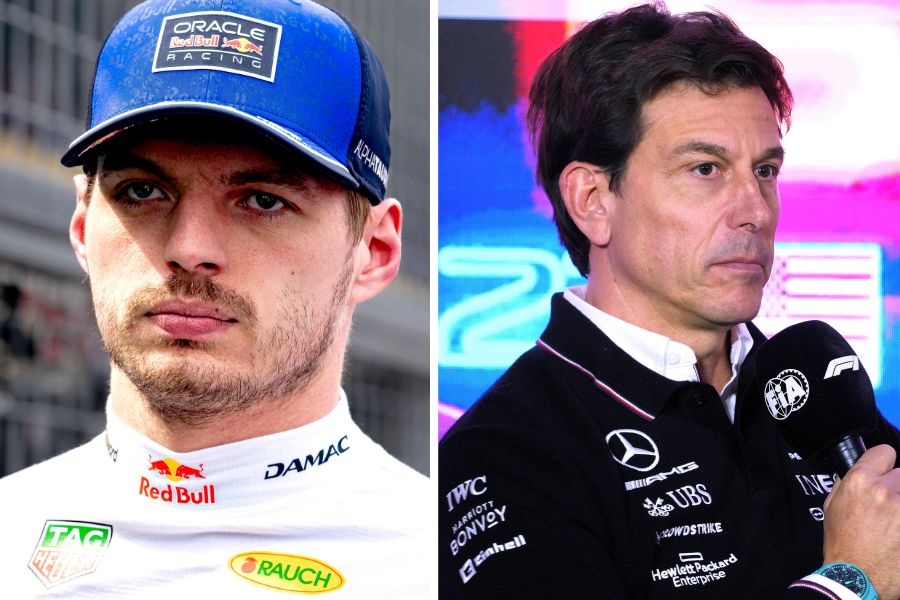
"Mario Kart," "Formula E on Steroids," and "Anti-Driving" – those are the phrases Max Verstappen has currently used against the new F1 regulations. After three races, he stands in ninth place in the drivers’ standings and is considering walking away from F1 at the end of 2026.
Toto Wolff, however, isn't having any of it. Mercedes has dominantly won all three races this year, with George Russell winning the Australian GP and Kimi Antonelli winning the next two in China and Japan.
Contrarily, Red Bull, currently on its first-ever in-house power unit, isn’t looking like a car anyone wants to drive. While the PU, co-created with Ford, isn't the issue, the chassis and aero are big pain points.
It is exactly because of this that Wolff has said that it’s probably the car that Verstappen drives that is making him complain.
"Max is really, I think, in a horror show. When you look at the onboard that he has in qualifying yesterday, this is just horrendous to drive. You can see that," said Wolff after the Chinese GP.
Though Max Verstappen's criticism found many backers in the paddock, Toto Wolff had an opposite view on the new regulations.
"It’s not the same as many other teams. I think from an entertainment perspective, I believe that what we’ve seen today between Ferrari and Mercedes was good racing. Many overtakes. At the moment, all the indicators say and all the data say people love it," Wolff concluded
F1 Regulation Rehash Incoming in 2026?
While Toto Wolff has strong words about how good the 2026 regulations are, F1 is already reconsidering changes to the battery recharge system that has already led to a 50G crash in Japan.
With the way the battery operates, drivers get to use a boost, which allows them to deploy their full battery power, gaining around 50 km/h on the car ahead. On the other hand, when a car's battery is drained, its speed reduces as the driver tries to recharge it.
Earlier this year, Carlos Sainz and Fernando Alonso had flagged closing speeds as a major problem when a driver is in overtake mode while the car ahead is recharging. But it took the crash of Haas' Oliver Bearman at the Japanese GP to get Formula 1 to take a closer look at the regulations.
Bearman, who was going flat out with boost into the Spoon Curve in Suzuka, came way too close to Franco Colapinto’s Alpine, which was recharging and going around 50km/h slower than Bearman. The Haas driver took evasive action and went onto the grass before crashing into the barriers at 50G, leaving Japan with a major impact to the right knee, luckily without a fracture.
Though the FIA has promised to re-examine the regulations and battery usage, there won't be any major changes this year.
Written by

Debrup Chaudhuri
Edited by

Yask Kotak