
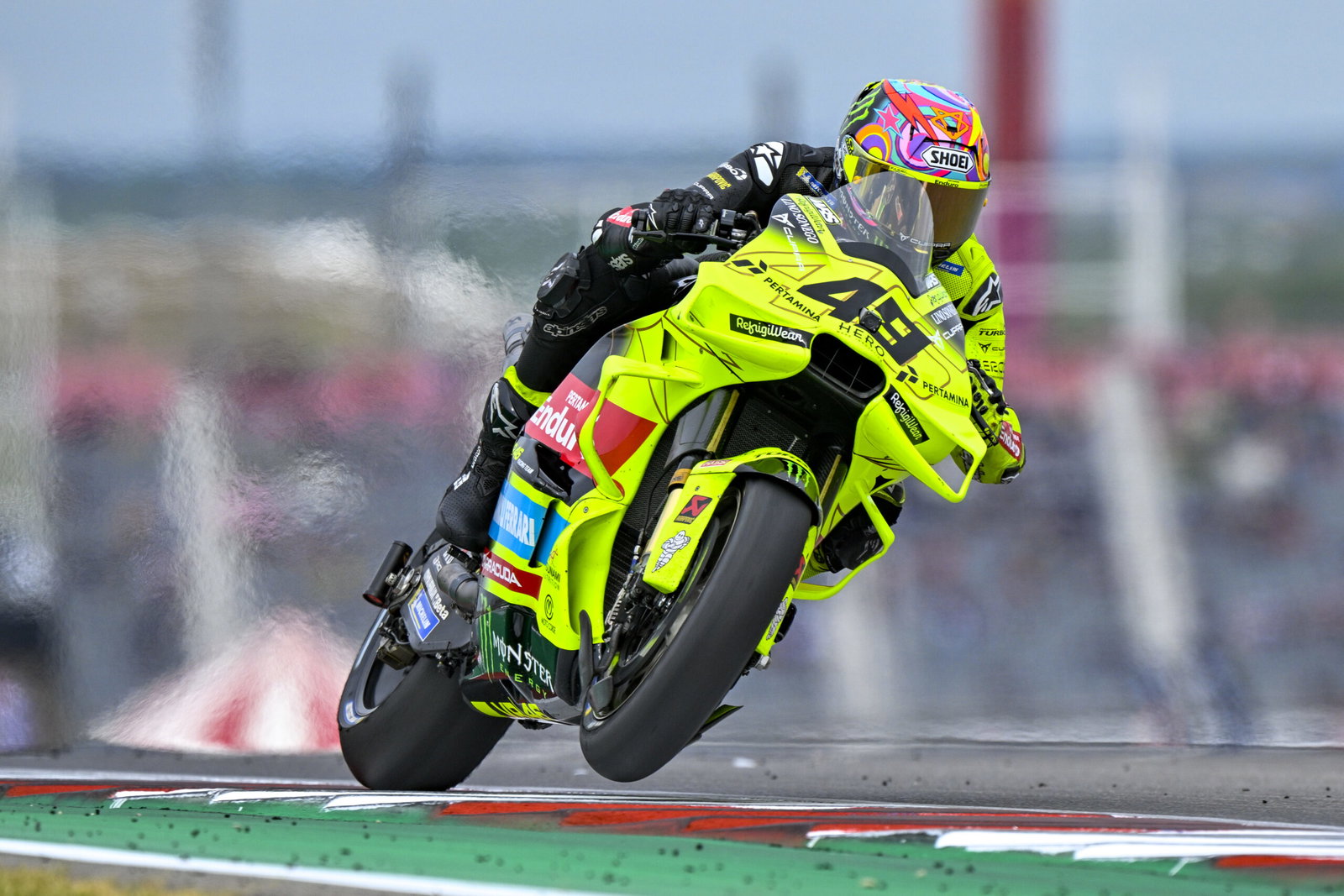
Mar 28, 2026; Austin, TX, USA; Team VR46 Fabio di Giannantonio (49) rides during practice and qualifying for the 2026 Red Bull Grand Prix of the United States at Circuit of The Americas Austin. Mandatory Credit: Jerome Miron-Imagn Images
Mar 28, 2026; Austin, TX, USA; Team VR46 Fabio di Giannantonio (49) rides during practice and qualifying for the 2026 Red Bull Grand Prix of the United States at Circuit of The Americas Austin. Mandatory Credit: Jerome Miron-Imagn Images
Jun 23, 2026, 3:08 AM CUT
MotoGP bans controversial equipment amidst rising safety risks
Even as plenty of things are set to change from the 2027 season onwards, MotoGP has decided to roll out two major changes that will take effect almost immediately.
Firstly, the racing series has officially banned the use of front holeshot devices with immediate effect. This means that riders will only have access to rear holeshot devices at the upcoming TT Assen in the Netherlands this weekend. Interestingly, the series will do away with holeshot devices entirely in the 2027 season.
The front holeshot device was primarily used at the start of races to lower the motorcycle's stance by locking the front suspension. This would lower the motorcycle’s center of gravity and prevent it from wheelie-ing during launches. However, it also compromises cornering and has to be deactivated via hard braking before the first corner, which could lead to crashes under braking.
The OEMs themselves viewed the device as an expensive add-on with no benefit to racing, and while Pedro Acosta feels that MotoGP should have removed both holeshot devices right away, others, such as Marco Bezzecchi and Fabio Quartararo, felt that the immediate removal was not a perfect solution.
The second change comes to the grid layout. In order to aid safety, it sees changes across MotoGP racing categories. The distance between each rider changes from three metres to four metres, effective from the German Grand Prix.
The distance between each row will also change from nine metres to 12 metres. There will still be three riders per row, just with more space between them.
Moreover, from the 2028 season, manufacturers will only be able to supply to two satellite teams, in addition to their factory team. This means that there will be six riders per team, under the condition that at least five manufacturers are competing in MotoGP.
It is also likely to stay in place till 2031, which is also the duration for the new Concorde agreement.
The new MotoGP Concorde agreement
The MotoGP group announced on Friday that, along with the five manufacturers: Aprilia, Ducati, Honda, KTM, and Yamaha, it has signed the framework for its new Concorde agreement. Thus, bringing an end to a year of negotiations between OEMs and the MotoGP Sports Entertainment Group.
The contract will define the commercial structure, regulatory, and sporting foundations of MotoGP for years to come, and while MotoGP.com has announced the contract will last from 2027 to 2031, there is reportedly the possibility of extending it to 2036.
Besides financial and commercial matters, the MotoGP Sports Entertainment Group is also said to be pursuing a heavy marketing push, focusing on fan engagement, team promotions, and more visibility across various platforms, in a similar vein to Formula One, which has seen a renewed interest, particularly among youngsters.
The negotiations, however, were tense, and it came down to financial reasons. The OEMs and teams were pushing hard for MotoGP to adopt a similar percentages-based business model as F1, which would give them a larger share of the championship’s revenue. However, teams have reportedly agreed on a fixed revenue model.
Written by

Aaradhya Singh
Edited by

Yash Kotak